Summer humidity across Mecklenburg County creates breeding habitats for Aedes albopictus, known as the Asian tiger mosquito, which thrives in shaded hardwood foliage around Myers Park, Dilworth, and Cotswold. Effective…
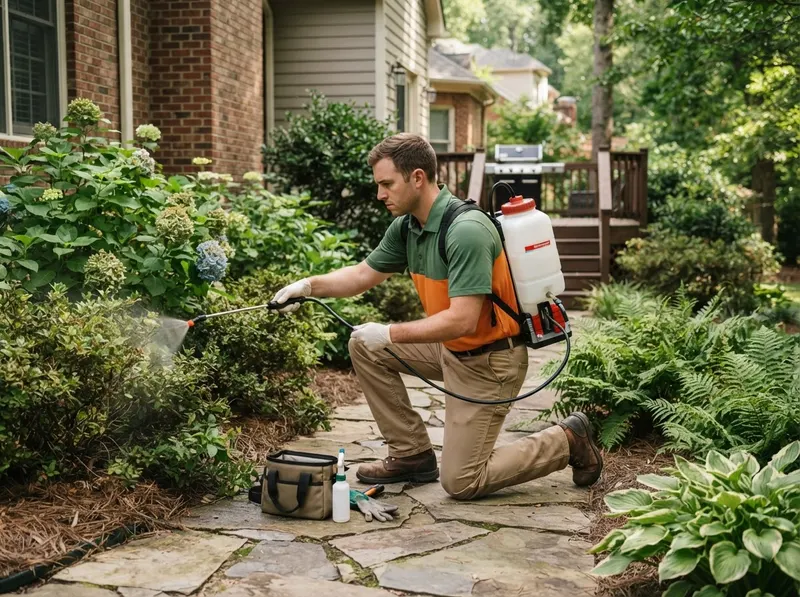
Summer humidity across Mecklenburg County creates breeding habitats for Aedes albopictus, known as the Asian tiger mosquito, which thrives in shaded hardwood foliage around Myers Park, Dilworth, and Cotswold. Effective perimeter suppression treats the underside of broad-leafed plants, ornamental hedges, and damp mulch beds where adult mosquitoes harbor during daytime heat. The process pairs micro-encapsulated adulticides with biological larvicide rings placed into catch basins, French drains, and low-lying ground depressions. A complete liquid perimeter band applied 3 feet up foundation masonry and 3 feet outward onto the soil prevents crawling insects from exploiting weep holes and subfloor penetrations. When properties feature dense canopy cover and heavy leaf litter near outdoor dining decks in NoDa or Plaza Midwood, systematic foliage misting breaks the reproductive cycle without broad-spectrum chemical saturation across lawn grass.
Property owners evaluating outdoor pest management face a trade-off between targeted monthly suppression treatments and permanent automated perimeter misting equipment. An automated misting installation requires high upfront plumbing expenses, ongoing mechanical maintenance, and runs on rigid timers that discharge regardless of wind direction or beneficial pollinator presence. Targeted barrier suppression fits seasonal mosquito peaks from April through October, allowing precise adjustments based on current moisture levels, yard drainage, and planned outdoor hosting events. If a yard spans less than half an acre in Elizabeth or South End with high foot traffic, manual backpack barrier misting provides immediate knockdown while keeping treatments strictly targeted away from vegetable gardens and flowering ornamentals. Heavy afternoon cloudbursts can shorten barrier longevity, requiring water-resistant micro-encapsulated formulas that bond directly to foliage cuticle layers rather than washing away into local municipal storm runoff.
The application process follows three standardized steps for domestic safety and property defense. First, a certified technician surveys the terrain, cataloging standing-water holding spots, shaded resting foliage, and home structural entry gaps. Second, technicians treat perimeter drainage zones with target-specific Bacillus thuringiensis israelensis (BTI) tablets that eliminate mosquito larvae without impacting local aquatic life or birds. Third, operators apply the low-toxicity perimeter micro-emulsion barrier along structural perimeters and dense brush lines, allowing a 30-minute drying window before family members and domestic pets re-enter treated turf and recreation spaces.
Every job gets a firm, written price after a free on-site visit.
Tell us about your mosquito and outdoor perimeter suppression job in Charlotte and we'll send a clear, written quote, usually the same day.
 Willow Ridge Pest Control