Mecklenburg County features dense, red clay soils that trap ground moisture directly beneath pier-and-beam foundations. In historic neighborhoods like Dilworth, Myers Park, and Plaza Midwood, older brick crawl spaces…
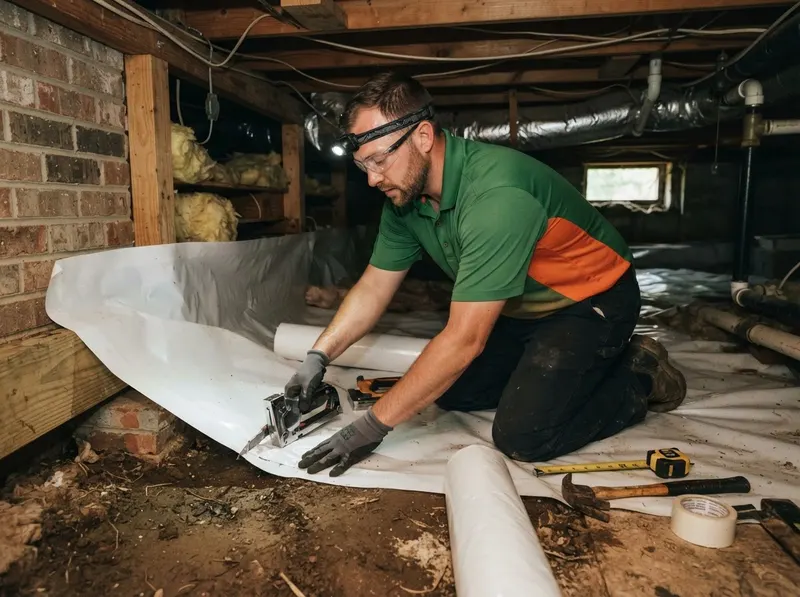
Mecklenburg County features dense, red clay soils that trap ground moisture directly beneath pier-and-beam foundations. In historic neighborhoods like Dilworth, Myers Park, and Plaza Midwood, older brick crawl spaces with passive foundation vents routinely draw in humid summer air, causing moisture levels in subfloor framing to exceed 20 percent. High wood moisture creates ideal breeding conditions for subterranean termites, wood-boring beetles, and American cockroaches, which migrate into upper living areas. Stabilizing the substructure removes the water source these pests require to survive, protecting floor joists from fungal rot and eliminating foul, musty odors rising through floorboards.
Selecting the correct moisture remediation method depends directly on foundation elevation and seasonal water intrusion. A 6-mil to 10-mil poly vapor barrier installed over open dirt floors fits dry crawl spaces requiring basic soil degassing. When relative humidity consistently spikes above 70 percent, full encapsulation with a continuous 12-mil or 20-mil reinforced barrier, taped seams, closed foundation vents, and an Energy Star dehumidifier delivers lasting control. The trade-off is mechanical maintenance: passive barriers require zero electrical power but cannot actively dry saturated air, whereas mechanical dehumidification requires ongoing filter changes every 6 to 12 months alongside electricity use to guarantee target humidity levels.
Structural moisture remediation follows a precise 4-step sequence to restore household safety. Step 1: Technicians record baseline wood moisture equivalent and ambient humidity across all foundation zones using pin probes and hygrometers. Step 2: Crews remove wet organic debris, scrap timber, and deteriorated insulation that shelter nesting camel crickets or rodents. Step 3: Installers anchor durable polyethylene liners across the earth and run sheeting up foundation walls, sealing seams with specialized mastic tape. Step 4: A dedicated, low-clearance crawl space dehumidifier is leveled on vibration pads and plumbed directly to an exterior gravity drain, keeping running operations discreet and maintenance-free.
Every job gets a firm, written price after a free on-site visit.
Tell us about your crawl space moisture control job in Charlotte and we'll send a clear, written quote, usually the same day.
 Willow Ridge Pest Control